



THE MARKET CONTEXT
Globally, the market context includes challenging decarbonization targets for the maritime sector, adopted by all stakeholders throughout the value chain:
alt
INTERNATIONAL MARITIME ORGANIZATION (IMO)
The United Nations agency responsible for preventing marine pollution from ships has set a Net Zero target by or around 2050.
alt
ETS
The European Union has decided to extend the ETS (Emissions Trading System) to maritime transport, a measure that entered into force on January 1, 2024.
alt
NET ZERO FLEET
Shipowners have adopted the “Net Zero Fleet” target.
FINCANTIERI NET ZERO

Faced with a market context targeting Net Zero in the Cruise sector by 2050, we are working to move ahead, with an internal target of 2035, while considering the available technology, regulations, and infrastructure. In this effort, we are involving all relevant stakeholders, especially our suppliers, clients, flag authorities, and port authorities.

Ahead of our Net Zero ship, we plan to deliver the first high-efficiency LNG unit by 2025, and a ship with minimal port emissions, equipped with dual-fuel engines (green fuels), fuel cells, and batteries by 2030.

2022
2025
2030
2035
-32% High efficiency
MGO-powered ship
-55% High efficiency
LNG-powered ship
-61% Minimal port emissions thanks to dual-fuel internal combustion engines, fuel cells, and batteries.
NET-ZERO NET-ZERO with new fuels ICE-based generation
To learn more about our strategies for shipbuilding
Our ecodesign system

In line with our Environmental Policy and the objectives of our Sustainability Plan, we have established an ecodesign system to promote the development of environmentally sustainable ships. We set objectives for each project, so that the assumptions, principles, and KPIs identified to deliver an eco-friendly product are reflected in design choices, as well as in the acquisition of systems and machinery constituting the ship product, in accordance with the ecodesign procedure.

In 2024, we continued along this path, updating initiatives based on the latest technological developments and removing those that, now widespread, are no longer considered innovative. As part of the same policy, we have defined criteria for the various environmental aspects to internally enhance the technological solutions adopted for each shipbuilding project. This approach makes it possible to compare different builds and monitor the environmental sustainability trends of products over time.

Ecodesign criteria are applied throughout the entire ship lifecycle:
alt
alt

During the design phase, the criteria adopted make it possible to identify solutions to:
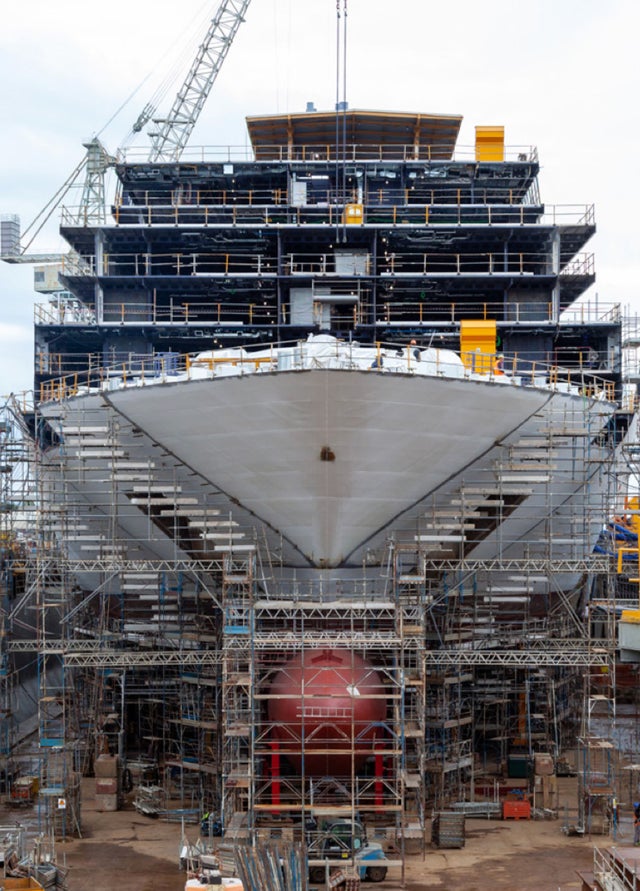
  • reduce the environmental impact of materials introduced into the production unit for construction, for example by reducing emissions and the use of energy and hazardous substances
  • reduce air and marine pollution
  • manage and treat waste generated on board (dehydration, stabilization, and compaction for onboard storage or unloading ashore, replacing the incinerator with new technologies with low environmental impact)
  • reduce energy consumption.
LEARN MORE
alt
SUSTAINABLE DESIGN AND END-OF-LIFE MANAGEMENT
Design choices also take into account product decommissioning activities by selecting materials, components, and systems that can reduce the environmental impact of dismantling and disposal at end of life. Although the disposal of materials at the end of the ship’s operational life is managed directly by shipowners, all our cruise ships are provided with voluntary certifications such as Green Passport, Clean Ship, or Eco (depending on the classification societies). All military vessels are delivered with the Green Passport, and some also carry Clean certification.
logo cleanship
The commitments of the 2023–2027 Sustainability Plan related to the environmental impact of products and services
In the following tables, you can find the objectives and targets of the 2023–2027 Sustainability Plan for the development of eco-sustainable products and services, with the aim of contributing to a circular and low-carbon economy.
Identify initiatives and projects for the development of products and design tools aimed at defining ships with reduced environmental impact
+
DESCRIPTION / TARGET TIMELINE PERIMETER STATUS SDGs
9 low environmental impact project initiatives (4 of which for the cruise business and 5 for the naval segment) 2025 Fincantieri S.p.A.
Work in progress
5 low environmental impact project initiatives (4 of which for the cruise business and 1 for the naval segment) 2027
Study on the circular economy for Fincantieri S.p.A. cruise ships in collaboration with a university/research center
+
DESCRIPTION / TARGET TIMELINE PERIMETER STATUS SDGs
Analysing the maturity level of players in the shipping industry 2025 Fincantieri S.p.A.
Achieved
The CIRCE (CIRCular Economy in Shipbuilding) project, aimed at studying the application of circular economy methodologies in the cruise sector, with a focus on Life Cycle Assessment (LCA), was carried out during 2024, ahead of the target set in the Plan for 2025. The five-phase project analysed three main segments of the ships: hull, cabins and HVAC system.
Identifying an analysis methodology
Evaluating and identifying tools to implement the logic of circular economy