Occupational Health & Safety, Environment, Biodiversity & Energy Policy


Protecting people’s health and safety, whether they are Fincantieri employees or employees of our suppliers, is a strategic priority and a fundamental part of the way we operate. Our approach integrates risk prevention and management, certified management systems, performance monitoring, training and awareness-raising, supply chain engagement, and the development of technological solutions aimed at improving workplace safety and ergonomics.
These commitments are implemented through our Occupational Health & Safety, Environment, Biodiversity & Energy Policy, approved by the Board of Directors, binding for all Group employees and addressed to all suppliers. The Policy is disseminated and shared through coordinated activities across the various production units.
Protecting the health and safety of our people is a strategic priority for the Group. With the ambition of building a Zero Accidents future, in 2023 we launched the Safety Improvement Plan, built around three key pillars: raising awareness, reporting, and continuous improvement.
We promote a safety culture based on dialogue and the active involvement of our people through structured engagement initiatives, on-the-job training activities, and communication campaigns aimed at increasing risk awareness and fostering safe behaviours.
At the same time, we continuously monitor HSE performance through reporting systems and analytical tools that enable us to promptly identify critical issues, share lessons learned, and define targeted corrective actions.
We also invest in innovative solutions and advanced technologies to make our workplaces increasingly safer, including intelligent systems supporting operational activities, driver assistance devices, artificial intelligence-based sensors, and exoskeletons designed to improve ergonomics and reduce the physical demands of work.
Our commitment to safety also extends to the supply chain through initiatives aimed at sharing best practices and continuously improving the health and safety standards adopted by partners operating at our sites.
Supporting this journey, the Zero Accidents Future On Board #SAFETYONBOARD campaign promotes a culture of prevention and shared responsibility, raising awareness among our people on the importance of maintaining constant attention to safety at all times.


To support a structured approach to prevention and protection, we adopt Health and Safety Management Systems aligned with international best practices, certified to the ISO 45001 standard across 100% of our Italian shipyards and 89% of the Group’s sites.
Through these systems, we identify and assess risks, define prevention and continuous improvement measures, monitor performance, and promote a strong safety culture at all levels of the organization. Activities include emergency management, the investigation of accidents and near misses, periodic audits and inspections, and ongoing training.
We continuously monitor the main health risk factors affecting our personnel through comprehensive occupational health surveillance programs, which include periodic medical examinations, specialist assessments and diagnostic tests.
Based on the evidence collected, we implement prevention and protection measures aimed at safeguarding the health and well-being of our people. Engagement with workers and their representatives also helps identify potential risk situations, including those related to work-related stress, and define targeted training and organizational measures.
We continuously work to improve our health and safety performance and reduce the risk of workplace injuries.
We systematically analyze accidents, injuries, and near misses involving both employees and contractors, identifying their root causes and defining corrective and preventive actions. The findings are shared across the various levels of the organization to foster continuous improvement and strengthen prevention efforts.
Safety is also built on dialogue and collaboration. For this reason, we promote regular coordination meetings among the stakeholders involved in the Group’s HSE governance, encouraging the sharing of experiences, knowledge, and best practices.
Our key prevention tool is the “Management Procedure for Injuries, Near Misses, Unsafe Conditions/Behaviours and Positive Feedback”, updated in 2023, which sets out how workplace injuries, near misses, unsafe conditions and behaviours, and positive feedback are reported and managed.
To ensure its effectiveness, we have implemented a digital support system that allows for the registration and management of Unsafe Observations related to each event, the archiving of photographic evidence, and the documentation of corrective measures taken.
Promoting a strong and shared health and safety culture means investing in people’s awareness and engagement, helping to create increasingly responsible workplaces that place collective wellbeing at the centre.
To this end, we provide continuously updated training programmes and awareness initiatives aimed at strengthening prevention, promoting safe behaviours across all operational settings and levels of the organization, and supporting our people in developing the skills and knowledge needed to work safely.
We developed a project to encourage healthy lifestyles, involving all employees of Fincantieri S.p.A. and its Italian subsidiaries, focusing in particular on healthy eating, responsible alcohol consumption, and medical prevention.
For each topic, we prepared an informational flyer, sent by email after the project launch. The communication and the three flyers were published on the company intranet and displayed on screens in the canteens. Paper copies were distributed to everyone through the most appropriate channels at each production site, handing them out at strategic locations such as company infirmaries.
The entire project was first shared with Workers’ Representatives and implemented in collaboration with the company’s Chief Medical Officer.
Through the Fincantieri Foundation, we have launched a strategic collaboration with Sapienza University of Rome to promote research and innovation in the fields of materials engineering and occupational medicine, with a specific focus on workers’ health and safety.
We aim to develop technological solutions that meet the standards required by next-generation shipbuilding. Fincantieri Foundation plays a central role in coordinating activities, strengthening the link between academia and industry and contributing to the development of an approach where safety is increasingly regarded as a shared and strategic value.
The objectives and targets relating to health and safety under the 2026-2030 Sustainability Plan are presented below.
| OBJECTIVE | TARGET | TIMEFRAME | SCOPE | SDG | |
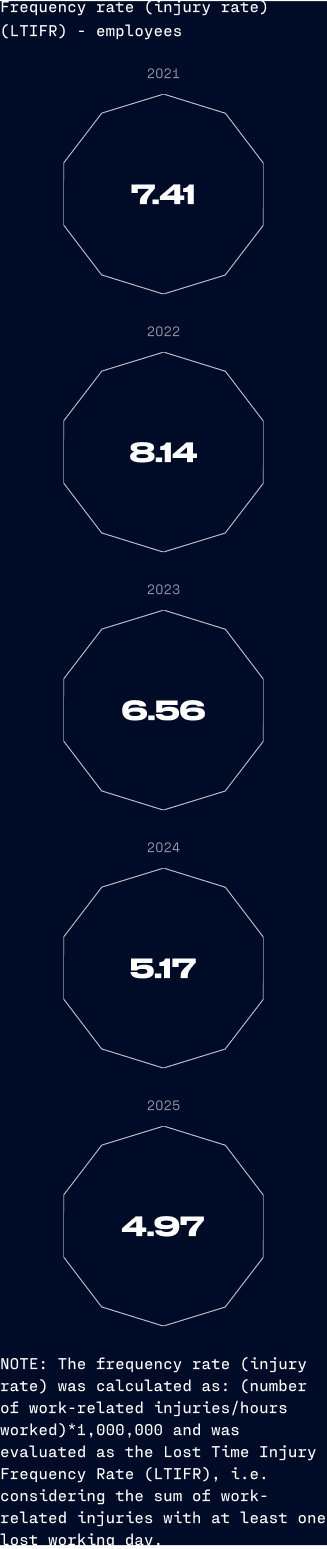
| Improvement of work-related Health and Safety performance, with the objective of progressively eliminating workplace accidents, in order to protect workers’ health and the working environment | BUSINESS PLAN TARGET 2026-2030 | Progressive reduction of the frequency rate* for work-related injuries among employees, using 2025 as the baseline year, in order to reach a rate of 6.5 by 2030 | 2.030 | Group | |
| Support tools aimed at improving ergonomics and reducing workloads | Progressive activation** of autonomous inspection and monitoring systems at shipyards, extending their adoption to Group companies, where applicable | 2.027 | Group | ||
* Injury rate (number of accidents at work/hours worked *1,000,000)
** Subject to the outcome of the feasibility studies.
Fincantieri adopts an integrated approach that includes risk prevention and management, certified Management Systems, performance monitoring, training and awareness-raising, supply chain engagement, and the development of technological solutions supporting workplace safety and ergonomics. These commitments are formalised in the Occupational Health & Safety, Environment, Biodiversity & Energy Policy.
The Policy covers the assessment and management of risks, workers’ training and awareness-raising, the improvement of working environments and ergonomics, the monitoring and improvement of occupational health and safety performance, the strengthening of safety governance, and the monitoring of exposure to substances of concern and noise, with the aim of preventing injuries and occupational illnesses and progressively reducing exposure to risks.
The Management System supports risk identification and assessment, the definition of prevention and improvement measures, emergency management, performance monitoring, the analysis of workplace injuries and near misses, and continuous training. The system is certified to the ISO 45001 standard across 100% of Fincantieri’s Italian shipyards and 89% of the Group’s sites.
Launched in 2023, the Safety Improvement Plan supports Fincantieri’s journey towards improved work-related health and safety performance through three main areas: awareness-raising, reporting and continuous improvement. The Plan integrates initiatives focusing on safety culture, HSE performance monitoring, the analysis of critical issues, the development of technologies supporting safety and ergonomics, and supply chain engagement.
Fincantieri monitors key health risk factors through occupational health surveillance programmes, including periodic medical examinations, specialist assessments and diagnostic tests. At the same time, it systematically analyses workplace injuries and near misses involving employees and contractors, identifying their causes and defining corrective and preventive actions. Dialogue with workers and their representatives also contributes to identifying risk situations and defining dedicated training and organisational measures.
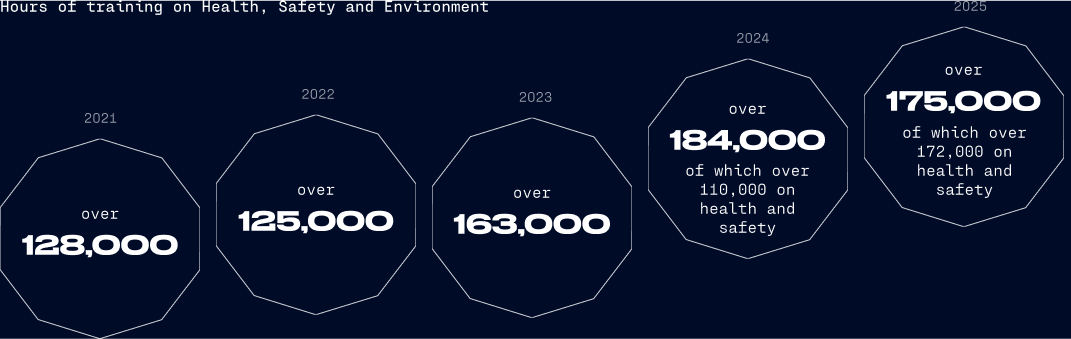
Training and awareness-raising are an integral part of Fincantieri’s approach to prevention. The company provides updated training programmes and information initiatives aimed at increasing risk awareness, promoting safe behaviours and developing the skills required to work safely. In 2025, more than 175,000 hours of Health, Safety and Environment training were delivered, of which more than 172,000 focused on health and safety.
The 2026-2030 Sustainability Plan provides for the progressive improvement of occupational health and safety performance, with the aim of progressively eliminating workplace injuries, as well as the development of technological tools supporting ergonomics and workload reduction. In particular, the Plan sets a 2030 target for the injury frequency rate and a 2027 target for the progressive activation of autonomous inspection and monitoring systems at shipyards, subject to the outcome of feasibility studies.